
讀這張圖,先分清三個數字
- 夜尿次數,看青色有幾格。 睡著後,中途起來排尿,之後還打算回去睡,這樣算一趟。
- 單次尿量,看每一格有多寬。 這一趟量杯接到多少毫升(mL),就是這一趟的尿量。
- 夜間總尿量,看整條色帶有多長。 半夜各次尿量相加+正式起床時的第一泡晨尿量=夜間總尿量。睡前最後一泡另外記。[12]
同樣是 600 cc,為什麼一晚一趟、另一晚三趟?
圖一是兩份虛構的排尿日誌。兩晚都在晚上 11 點上床,早上 7 點起床。青色是半夜起床排的尿,黃色是早上正式起床時的第一泡晨尿。
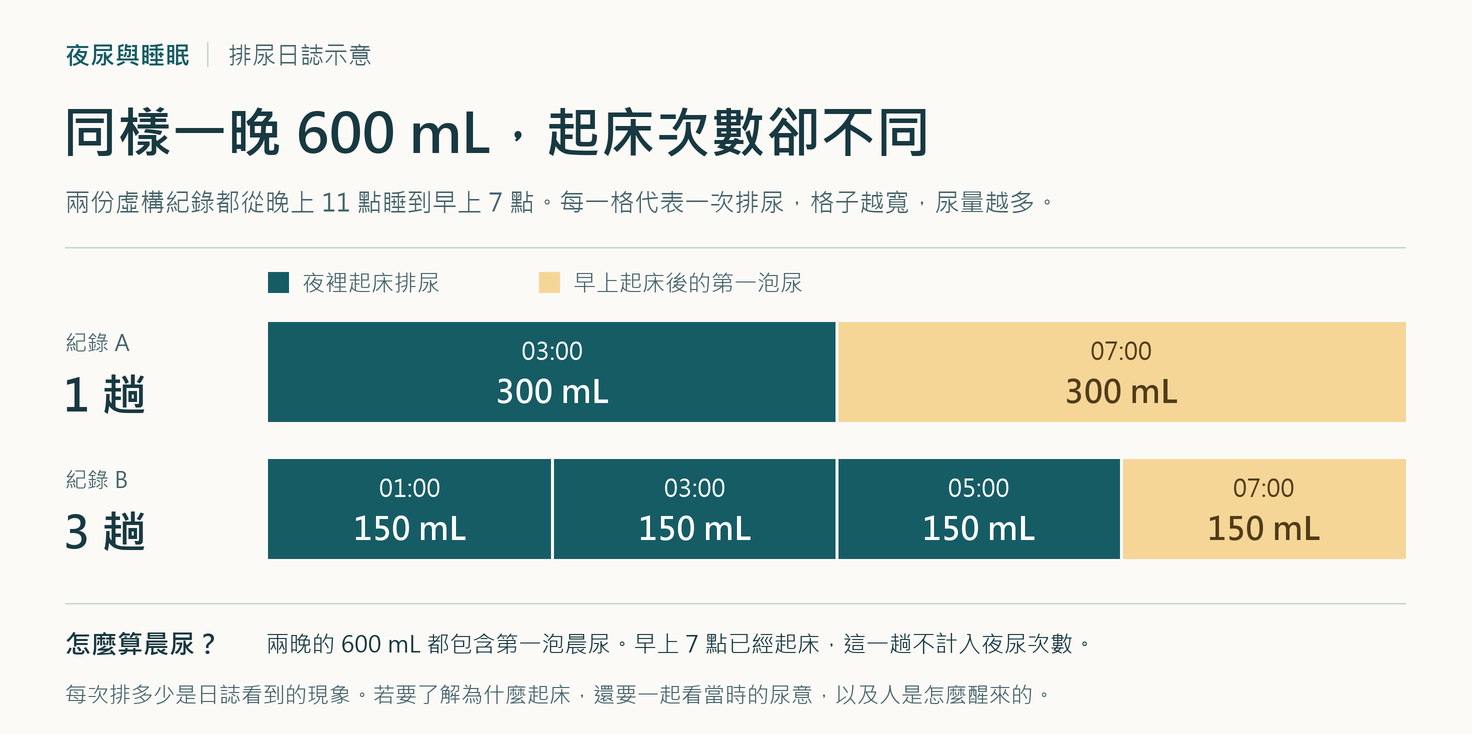
第一晚,凌晨 3 點起來排了 300 mL,回床繼續睡。早上的第一泡也是 300 mL。兩泡加起來 600 mL(600 cc),夜尿 1 次。
第二晚,凌晨 1 點、3 點、5 點各起來一次,每次 150 mL。半夜三泡合計 450 mL,再加上晨尿 150 mL,同樣是 600 mL,夜尿卻是 3 次。
第二條色帶明明有四格,為什麼只記三次?因為最後一格的尿是在睡眠期間累積,尿量要算進前一晚。到了早上 7 點,人已經起床開始一天,所以這一泡不再多算一趟夜尿。[12]
反過來,同樣起來三趟,整晚的尿量也會一樣嗎?
把第二晚改一個條件。半夜還是起來三趟,但三次都排了 300 mL,晨尿也是 300 mL。這晚合計 1,200 mL。和剛才的 600 mL 相比,跑廁所的次數一樣,整晚尿量卻變成兩倍。真實生活中每一泡通常不會剛好相等,照實量、逐次加總就好。
腎臟在夜裡持續製造尿液,膀胱負責把尿暫時存起來。整晚尿量相近時,如果膀胱存到較少的量就出現強烈尿意,人可能較常起床。反過來,即使每次能舒服儲存的量差不多,碰上夜裡產尿較多,也可能提早需要去廁所。所以要把「一晚總共有多少」和「每次排了多少」放在一起看。 [5][6]
每晚都起來兩次,日誌可以是兩種樣子
義大利一項研究請 84 位因夜尿就診的成人記三天日誌,觀察一整天的尿是否有較高比例集中在睡眠時段,也就是夜間多尿。研究者還用超音波量排完後的餘尿,把它加回排出的尿量,估計膀胱當時存了多少,再看平均容量是否偏低。[9]
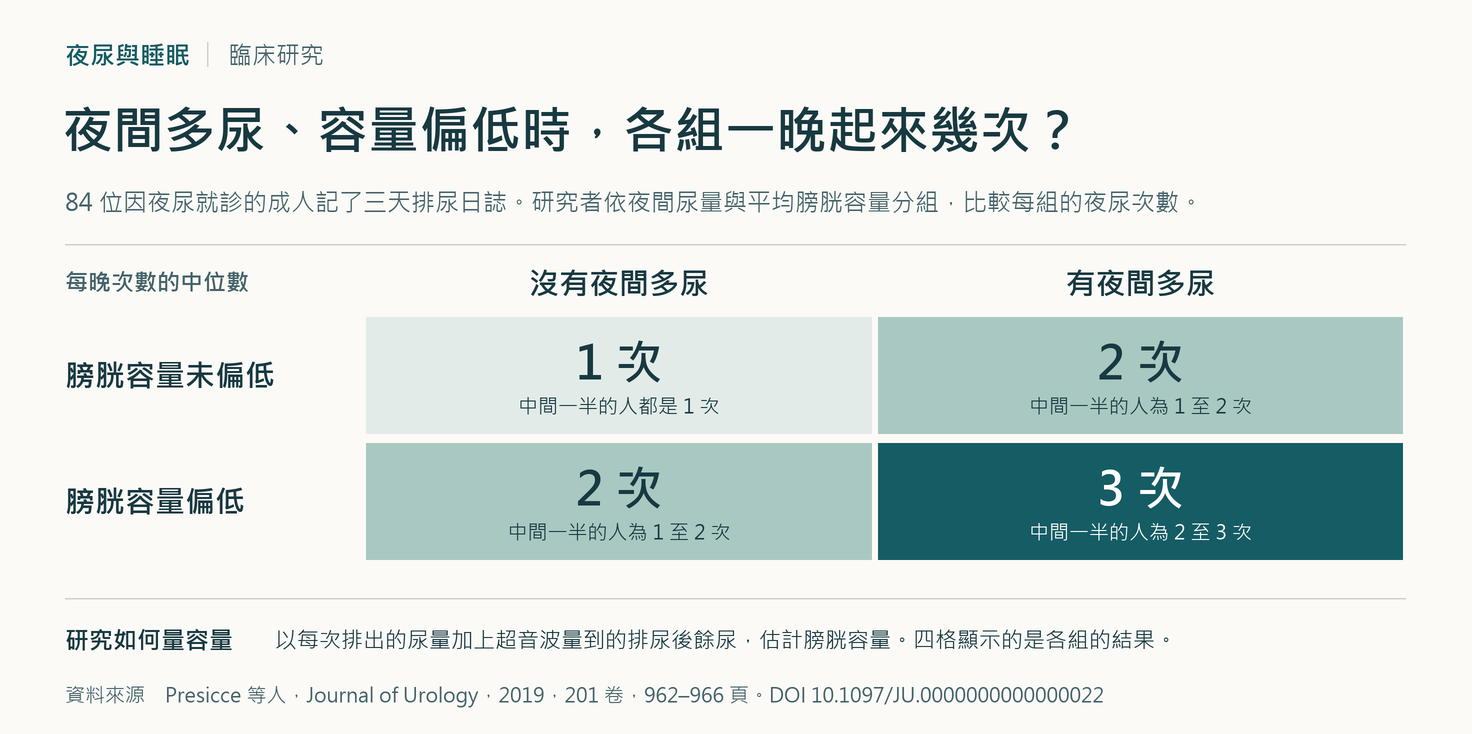
最值得看的是右上格和左下格。右上格的人夜間多尿,平均膀胱容量沒有偏低。左下格的人夜間產尿的比例沒有偏高,平均膀胱容量卻較低。兩組每晚起床次數的中位數都是兩次。 當夜間多尿和容量偏低同時出現,中位數則是三次。這是這群患者的觀察結果。要了解你自己的情形,醫師會一起看白天和夜裡的紀錄。[9][11]
每趟只排 150 mL,就是膀胱只能裝 150 mL 嗎?
量杯告訴你的是這一趟實際排了多少。假設你白天曾一次排出 300 mL,半夜有一趟卻只有 150 mL,醫師就會想知道,你那一趟是什麼情況下去的。若白天和夜裡都常常只尿一點,而且每回都急得非去不可,這又是另一條線索。[7][10]
在三天的日誌裡,最大的一泡叫作最大排尿量。日誌反映你平常怎麼儲尿、何時決定去廁所。醫院若需要做膀胱測壓,則是在控制注水的檢查條件下量容量。這兩種數字可能相關,意義各有不同。[5][13][14]
醒來的先後,量杯量不到
同樣在凌晨兩點排出 150 mL,一晚可能是尿意很急,把你從睡夢中叫醒。另一晚可能是先被聲音吵醒,躺了一會兒,才決定順便去尿。量杯停在同一個刻度,該留意的事情卻不一樣。多記下「被尿意叫醒」「先醒後排」或「不清楚」,就把這一筆數字放回了當晚的情境。[3][12]
同樣地,如果後來少起來幾趟,改變的也可能是夜間產尿量。一項男性日誌研究就發現,有些人起夜次數和夜間尿量一起下降,日誌裡最大的一泡卻沒有明顯變大。[8]
看診時,把「三趟」說成自己的一個晚上
選三個能代表平常生活的日夜,照平時習慣喝水、按原醫囑用藥。記下白天和夜裡每次排尿的時間、尿量,標明上床、正式起床和第一泡晨尿。夜裡再多寫幾個字,記下醒來的第一個感覺。漏量就寫「未量」,不必猜數字。[12][15]
到診間時,你就可以說:「我昨晚起來三趟,每趟大約 150 mL,晨尿也是 150 mL,合起來 600 mL。第一趟是尿急把我叫醒,後兩趟是先醒了才去。最困擾我的是,第二趟之後很難睡回去。」
這段話交代了半夜起來幾次、整晚合計多少、每次排多少,也說出了你最想改善的事。若反覆夜尿已影響睡眠或白天精神,或白天也有尿急、漏尿、尿流變慢,可以帶現有紀錄和醫師討論。
相關閱讀
核心延伸閱讀
[5]
怎麼把一晚總量與一泡尿放在一起看
把一晚的尿量和這個人在日常最多排過多少放在一起,說明兩個數字怎麼幫助理解夜尿。
閱讀原文[6]
社區長者的三天日誌
比較 224 位社區長者的日誌,呈現為什麼單看夜間總尿量或單次尿量,兩群人的紀錄會彼此重疊。
閱讀原文[9]
圖二的四組資料從哪裡來
這是圖二的來源。研究以三天日誌和排尿後餘尿量,整理出四種夜間尿量與膀胱容量的組合。
閱讀原文[11]
尿量與儲尿因素可以並存
從門診日誌看見,夜尿頻繁的人可能同時有尿量與儲尿方面的因素。
閱讀原文[12]
第一泡晨尿怎麼算
界定什麼算夜尿、夜間尿量怎麼算,以及第一泡晨尿為何需要另外標記。
閱讀原文[15]
為什麼要記幾個日夜
比較同一個人不同日子的日誌,說明只看單一夜晚容易錯過哪些變化。
閱讀原文研究範圍與補充說明
600、300 和 150 mL 是虛構日誌的示範數字。個人夜間產尿是否偏多,要連同全天尿量和主要睡眠時段來判讀。一次排出的量也會受到尿意、是否先醒來,以及膀胱排空情形影響。圖二來自單一中心的群體研究,分組數字供理解這些因素如何重疊。
本文提供一般醫學與健康教育資訊,不能取代醫師依個別病史、檢查結果及實際狀況所做的診斷與治療建議。
展開全部 15 項參考來源
- [1] Pesonen JS, Cartwright R, Vernooij RWM et al. The Impact of Nocturia on Mortality: A Systematic Review and Meta-Analysis. J Urol. 2020;203:486-495.
- [2] Bliwise DL, Howard LE, Moreira DM et al. Nocturia and associated mortality: observational data from the REDUCE trial. Prostate Cancer Prostatic Dis. 2019;22:77-83.
- [3] Negoro H, Setoh K, Fukunaga A et al. Risk analyses of nocturia on incident poor sleep and vice versa: the Nagahama study. Sci Rep. 2023;13:9495.
- [4] Graffen SC, Bin YS, Kairaitis K et al. Nocturia as a clinical marker of cardiovascular risk in obstructive sleep apnoea. Sleep Med. 2026;148:109188.
- [5] Weiss JP, Blaivas JG, Stember DS et al. Evaluation of the etiology of nocturia in men: the nocturia and nocturnal bladder capacity indices. Neurourol Urodyn. 1999;18:559-65.
- [6] Rembratt A, Norgaard JP, Andersson KE. Differences between nocturics and non-nocturics in voiding patterns: an analysis of frequency-volume charts from community-dwelling elderly. BJU Int. 2003;91:45-50.
- [7] Avulova S, Blanker MH, van Doorn B et al. Determinants of nocturia severity in men, derived from frequency-volume charts. Scand J Urol. 2015;49:185-8.
- [8] Epstein MR, Monaghan T, Weiss JP. Etiology of nocturia response in men with diminished bladder capacity. Neurourol Urodyn. 2019;38:215-222.
- [9] Presicce F, Puccini F, De Nunzio C et al. Variations of Nighttime and Daytime Bladder Capacity in Patients with Nocturia: Implication for Diagnosis and Treatment. J Urol. 2019;201:962-966.
- [10] Monaghan TF, Bliwise DL, Dmochowski RR et al. Associations between nighttime and daytime maximum voided volumes: Relevance for nocturia?. Neurourol Urodyn. 2020;39:2301-2304.
- [11] Yoon JH, Lee K, Park EJ et al. Analysis of changes in the pathophysiology of nocturia according to the number of nocturia episode, age, and gender using frequency volume charts: A retrospective observational study. Medicine (Baltimore). 2022;101:e31295.
- [12] Hashim H, Blanker MH, Drake MJ et al. International Continence Society (ICS) report on the terminology for nocturia and nocturnal lower urinary tract function. Neurourol Urodyn. 2019;38:499-508.
- [13] van Venrooij GE, Eckhardt MD, Gisolf KW et al. Data from frequency-volume charts versus filling cystometric estimated capacities and prevalence of instability in men with lower urinary tract symptoms suggestive of benign prostatic hyperplasia. Neurourol Urodyn. 2002;21:106-11.
- [14] Kim MH, Suh J, Kong HJ et al. Maximum Voided Volume Is a Better Clinical Parameter for Bladder Capacity Than Maximum Cystometric Capacity in Patients With Lower Urinary Tract Symptoms/Benign Prostatic Hyperplasia: A Prospective Cohort Study. Int Neurourol J. 2022;26:317-324.
- [15] Park S, Kang W, Lee DG et al. Is it effective to do mathematical analysis for the etiology of nocturia using the nocturia indices derived from the frequency volume chart?: A retrospective observational study. Medicine (Baltimore). 2025;104:e42222.